The Candle on the Counter
What I've learned about loving animals you know you'll outlive — and how to decide how hard to fight.
There's a candle on the front counter at my vet's office. It's not a real one. It's one of those battery flames that flickers a little too evenly, sitting next to a framed watercolor sign, a box of tissues, and a pump bottle of hand sanitizer. The first time I noticed it, I didn't think anything of it. Now I know exactly what it means. When the candle is lit, someone in the clinic is saying goodbye to their best friend.
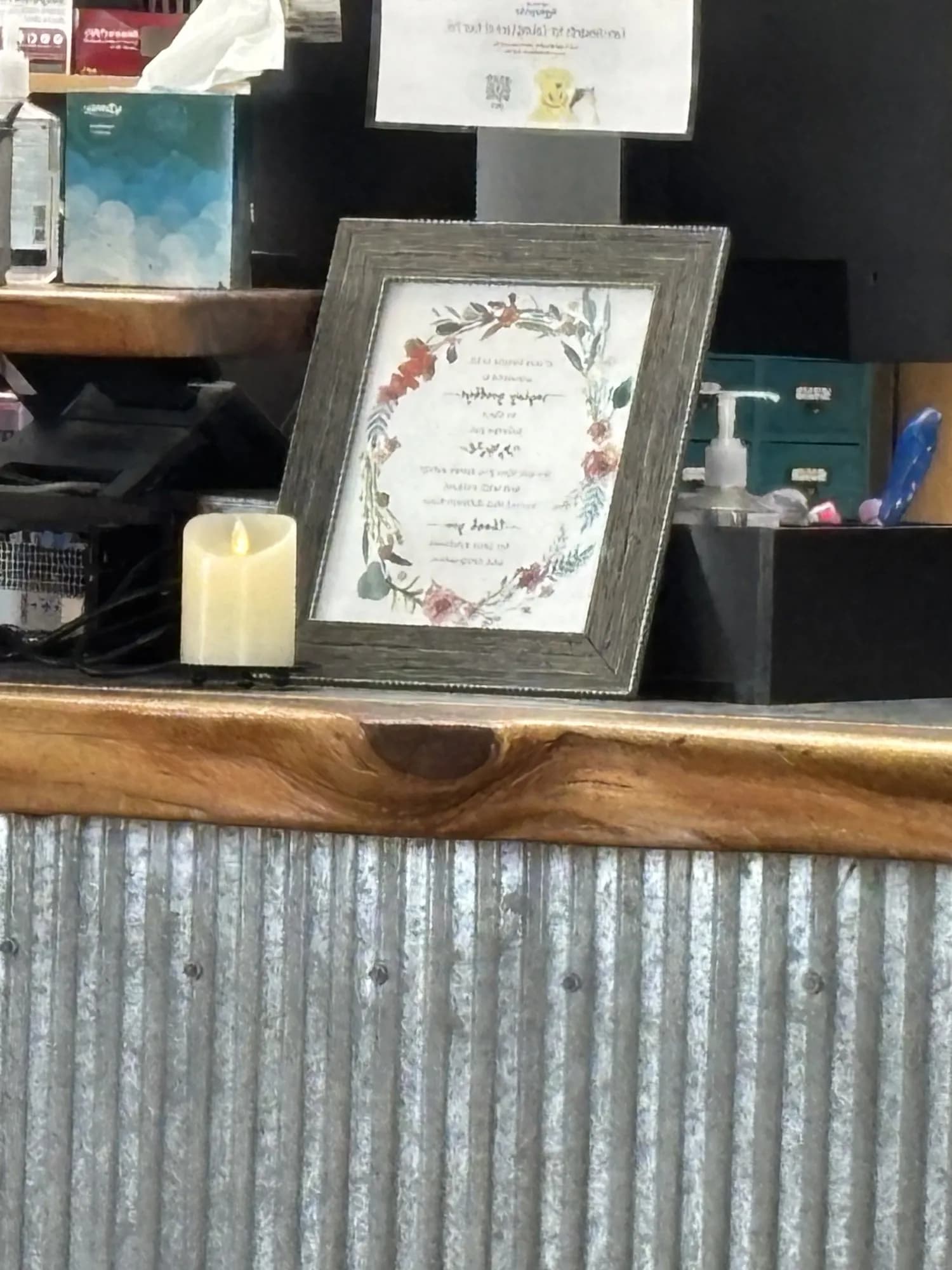
I know this because I am there a lot. More than I want to be. My house is full of animals, and most of them are old, and old has its own kind of challenges. So, I've learned the rhythms of the place the way you learn a second home you never asked for — where to park, which tech runs behind, and what it means when you walk in, and the flame is already going.
I walked in last week with my cat, my dog who had spit out a pain pill and then, with the particular genius of cats, eaten it off the floor anyway. A small emergency. Nothing, really, compared to what the candle was for that day. But that's the thing about becoming a regular at the vet. You stop being only a person with your own crisis. You become a witness to everyone else's.
I should say, plainly, that I'm writing this two weeks after my mother died. I don't think you can separate that from the rest of it. I've been spending a strange amount of time in waiting rooms in the same weeks I lost her, and the candle has hit differently because of it. Grief doesn't sort itself by species. It just shows up, and lately it keeps showing up where the animals are, because they're the ones in front of me.
In the last stretch of visits, I've watched five animals not make it. Some were helped along gently; some lost their footing on the table during treatment. I wasn't in the room for most of them. You don't have to be. You feel it move through a waiting room: the front desk goes quiet, a door stays shut a beat too long, someone walks out holding a leash with no pet on the end of it, and on the counter, the flame is lit.
It has made me think hard about how much I fight for my animals. Financially, emotionally, and every other way. And how, in the end, I lose them anyway. That sounds like a reason to give up. It isn't. But it did force me to get honest about what fighting actually means, and when it stops being for them and starts being for me. That's what the rest of this is about — not because I've got it figured out, but because I wish someone had handed me a way to think about it before I was standing at that counter.
How to decide how hard to fight
Nobody warns you that loving an animal means signing up for a math problem with a fixed answer at the bottom. They live shorter lives than we do. If you do this right — if you love them well and keep them long — you will almost certainly be the one standing there at the end. Knowing that doesn't make it easier. But it does mean the real question was never whether you'll lose them. It's how you want to spend the time you have, and how you'll know when fighting has turned into prolonging.
Here's the framework I wish I'd had. It's not a formula. It's a set of honest questions to keep asking.
1. Separate “more life” from “less suffering”
These are not the same thing, and the hardest decisions live in the gap between them. A treatment can buy weeks and make every one of them miserable. Another can do nothing for the calendar but everything for comfort. When the vet lays out options, the question to ask out loud is: is this for length, or for quality? Sometimes you want both and can have both. Often you must choose. Naming which one you're actually investing in makes the choice cleaner, even when it's not easier.
2. Use a quality-of-life scale before you're desperate
There are real tools for this, and they help precisely because they take the decision out of one bad afternoon. The one most veterinarians point to is the HHHHHMM scale — Hurt, Hunger, Hydration, Hygiene, Happiness, Mobility, and More good days than bad. You score each one, you track it over time, and you watch the trend instead of agonizing over a single hard day.
The reason to start scoring early, before you think you need to, is that you'll have a baseline. Grief and hope both distort the picture. A number you wrote down last month, when things were better, is more honest than the story you'll tell yourself in the moment. Ask your vet to walk through the scale with you. It's a normal request. They'd rather have that conversation early than watch you suffer through it alone later.
3. Name your limits out loud, before the crisis
This is the unglamorous, deeply practical part. Decide, in a calm moment, what you can actually do — financially, logistically, emotionally — and say it to someone. There is no shame in any of these limits. A treatment you can't afford without wrecking your family isn't a measure of how much you love your animal. A two-hour daily medication routine you can't sustain isn't a failure of devotion. Pretending you have no limits doesn't help your animal. It just guarantees you'll hit the wall at the worst possible moment, with no plan.
Write down, roughly: what you're willing to spend, what kind of intervention is too much for this particular animal at this particular age, and what “too far” looks like to you. You can change your mind. But having said it once gives you something to stand on when you're standing on nothing.
4. Understand that choosing to stop is also fighting for them
This is the one that took me the longest. We treat euthanasia as the moment we gave up, as the opposite of fighting. It isn't. Choosing a gentle, planned goodbye over a frightening, drawn-out one is one of the bravest things you can do for an animal who can't understand why they hurt. It is, often, the last and best act of advocacy you have. The fight was never against death. It was for their comfort and their dignity, and sometimes that fight ends with letting go on purpose, on a good day, instead of a terrible one.
I've sat close to a slow, hard goodbye lately — the human kind — and it rearranged how I think about this. Watching a prolonged ending up close makes you understand, in your body and not just your head, the difference between a death that drags and a death that's met with mercy. I don't say that to compare the two. I say it because it's the thing that finally made me stop flinching from the word, and start seeing a calm, chosen ending for what it actually is.
5. Know what you're allowed to ask for
Most people don't know how much agency they actually have at the end, so they get ambushed by it instead of planning it. You can ask to be in the room. You can ask what the process actually involves, step by step, so nothing surprises you. You can ask about sedation first, so your animal is calm and unafraid. You can ask about at-home euthanasia, so the last place they know is their own bed and not a vet office. You can ask for a few minutes alone, before and after.
With one of my dogs, I had the chance to be in the back with him, to have my hands on him the whole time. I didn't know to ask for that until I was lucky enough to be offered it. Most people aren't told it's an option. It is. Ask.
Back at the counter
Here is what I've come to, standing in that waiting room more times than I'd like, in a season where I'm already grieving a person and not just the animals. The candle isn't morbid. It's the opposite. It's a small, deliberate act of respect — a way of saying, out loud and without words, that something real is happening behind that door and the rest of us should soften for a minute. Somebody decided that grief deserved to be marked, even in a busy clinic with a line at the desk and a dog barking in the lobby.
I fight hard for my animals, and I lose them anyway. Both of those things are true, and neither one cancels the other out. What I've stopped doing is mistaking the length of the fight for the quality of the love. Love isn't measured by how long I can keep them here. It's measured in whether I paid attention, whether I was honest about what they needed instead of what I needed, and whether I had the nerve to choose a good ending when a good ending was the only kind left.
So, if you're newer to this than I am, or just dreading the part of the road you can see coming, that's the whole thing I'd want you to know. Decide what fighting means before you're desperate. Track the good days against the bad ones. Name your limits without shame. Ask for what you're allowed to ask for. And when the candle gets lit for you — and someday it will — try to walk out knowing you didn't spend the time you had bracing for the end. You spent it loving the animal who was still here.
A note on the hardest decisions
Every animal and every situation is different, and nothing here replaces a conversation with your own veterinarian. If you're facing a quality-of-life or end-of-life decision, ask your vet to walk you through it directly — including the HHHHHMM scale and your options for a calm, planned goodbye. You don't have to figure it out alone.
At petcareally.ai, you can organize what you're seeing, think through the questions that actually matter, and show up to that conversation clearer than you would have on your own. It doesn't diagnose your pet or replace your veterinarian. It is a steady place to think when the decision is heavy.
Try PetCare AllyAuthor: Laura Strausberg, Founder of PetCare Ally — Laura built PetCare Ally after navigating her own difficult pet care decisions and wanting something better for the moments when you are scared, uncertain, and trying to do right by the animal you love.
Medically reviewed by Dr. Shelby Neely, VMD.
This article is for educational purposes only and is not a substitute for professional veterinary advice, diagnosis, or treatment. Always consult your veterinarian with questions about your pet's health.